


 10.09.2026 06:41 PM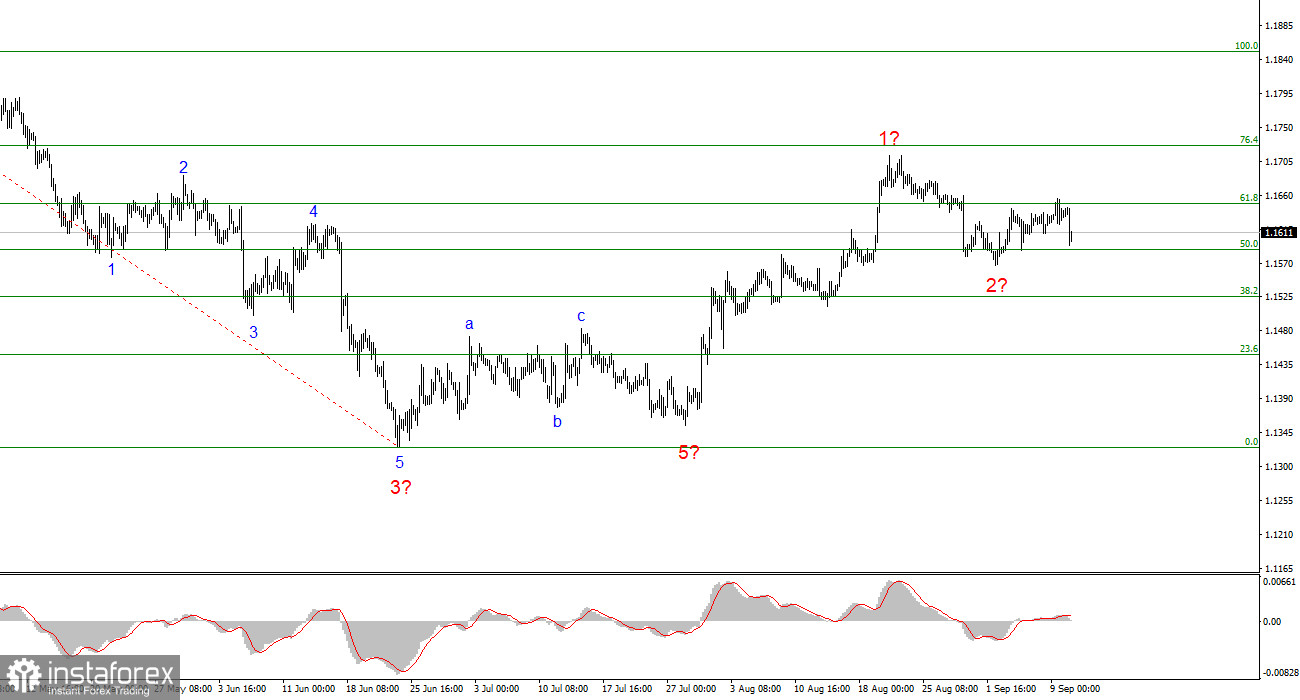
The wave count on the four-hour chart for EUR/USD is becoming more complex. There is still no question of canceling the upward trend segment (lower chart) that began in January last year. On the contrary, we have seen a full corrective A-B-C structure, which has most likely been completed. We never saw a convincing wave 5 in C. This wave took a truncated form, which also happens from time to time. Let me remind you that classical wave structures are generally found only in textbooks. In real-life trading, traders and analysts should be more flexible in their analysis.
The wave count may once again develop into a more complex structure. Wave C may take a three-wave form, the wave that follows it would then be identified as wave D, and the entire trend segment that began on January 27 would take a five-wave corrective form, A-B-C-D-E. If this assumption is correct, wave D will take a three-wave form, and on August 21, EUR/USD entered the phase of forming wave E, whose low should be below the low of wave C at 1.1325. At the same time, however, this scenario is a backup scenario. Based on the news backdrop, I am more inclined toward the formation of a global upward wave and an upward trend segment.
The ECB Triggers a Mixed Market Reaction
The EUR/USD pair declined by 20 basis points during Thursday's session as of the time of writing this review. However, the important point is not the euro's 20-point decline. Twenty points is insignificant, especially against the backdrop of such an important event as a central bank meeting. What matters is the market's reaction to today's events. The first thing I want to note is the selling of the euro instead of buying. The second is the rather weak market reaction to an important event. The third is the rapid upward retracement in prices. Let us examine all three points in more detail.
Why did the market reduce demand for the euro if the ECB raised interest rates? There is nothing complicated about this. In the days leading up to the meeting, market participants were confident that the ECB would tighten monetary policy, so this scenario had already been priced in before the meeting. At the same time, even if it had been priced in, this does not mean that the euro should decline. Therefore, I believe that the euro will return to the 1.1650 level today.
The relatively weak market reaction can also be explained by market participants' preparedness for the regulator's decision. Inflation in the European Union has accelerated throughout 2026, while the EU leadership is not demanding that the ECB cut rates, as Donald Trump has been demanding of the Federal Reserve.
The rapid upward retracement in the euro is explained by the fact that although the market had priced in the policy tightening in advance, this is not a reason to sell the euro. The ECB has already carried out its second round of tightening this year and has also made it clear that inflation will continue to rise as the conflict in the Middle East and the blockade of the Strait of Hormuz continue. Consequently, the current round of tightening will not be the last. So why should the euro decline?
General Conclusions
Based on my analysis of EUR/USD, I conclude that the pair remains within a local upward trend segment. I would note that the trend segment that began in January of this year may still take an A-B-C-D-E form. If this assumption is correct, the decline in prices will resume, with targets below the low of wave C at 1.1325. However, I consider this scenario an alternative. I believe that the formation of a new upward trend segment began in June, which will bring the euro back to the 20th figure and take it considerably above that level. Therefore, I remain inclined toward buying, with targets above the 17th level.
On the higher time frame, an upward trend segment can be seen, followed by the formation of an A-B-C corrective structure. This structure may take a five-wave form, but at present I consider it complete. If so, the formation of a new impulsive upward trend segment has begun.
The main principles of my analysis:

