
See also


 15.09.2026 09:07 AM
The price test at 154.660 occurred as the MACD indicator began moving up from the zero line, confirming a good entry point to buy the dollar. As a result, the pair rose toward 155.02.
Today's data showed Japan's services-sector activity index rose 0.4% month-on-month (seasonally adjusted) to 107.1 points, and the raw year-on-year index increased by 2.3%. The largest contributions to the rise came from leisure and entertainment services (+3.4%), retail trade (+2.1%) and transport and postal services (+1.8%).
Far more important for the yen is another story: currency interventions appear to have stopped, and the dollar has returned to rising against the yen for the first time in weeks. The joint US–Japan intervention that previously pushed the pair down from levels above 160 to around 153.40 no longer supports the currency, and without that backstop, USD/JPY again has room to move higher. In my view, the absence of fresh signals that authorities are ready to intervene frees dollar buyers, especially given that Japanese 10-year yields — though they did reach 3% for the first time in 30 years — have not yet been met with sufficiently forceful rhetoric from the Bank of Japan.
The USD/JPY advance unfolds just ahead of the Federal Reserve meeting, and I expect the US central bank's decision to be the key catalyst for the pair in the coming days. If the Fed confirms a tightening bias, the yield gap between the dollar and the yen will widen further, reviving carry-trade interest and giving the dollar an additional boost. The Bank of Japan meets on September 18, and until then I believe initiative will remain with USD buyers, since without renewed interventions and with Tokyo remaining cautious, the yen has little to hold on to.
For intraday strategy, I will rely mainly on Scenarios No. 1 and No. 2.
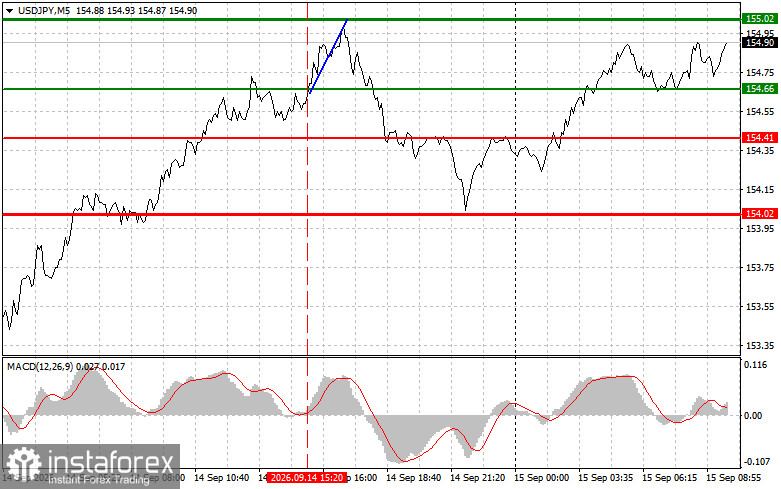
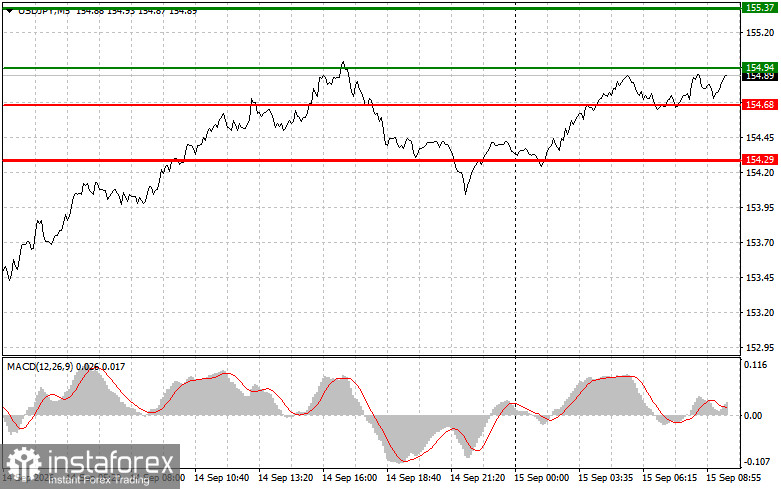
Scenario No. 1: I plan to buy USD/JPY today if the price reaches the entry area around 154.94 (green line on the chart), targeting a rise to 155.37 (the thicker green line). Around 155.37, I intend to exit long positions and open short positions in the opposite direction (expecting a 30–35 pip reversal from that level). It is best to return to buying the pair on corrections and significant USD/JPY pullbacks. Important: before buying, ensure the MACD indicator is above the zero line and only beginning to rise.
Scenario No. 2: I also plan to buy USD/JPY today in case of two consecutive tests of 154.68 while the MACD is in oversold territory. This will limit the pair's downside potential and lead to an upward reversal. One can expect moves to the opposite levels 154.94 and 155.37.
Scenario No. 1: I plan to sell USD/JPY today only after a break below 154.68 (red line on the chart), which would lead to a quick decline in the pair. Sellers' key target is 154.29, where I plan to exit shorts and immediately open longs in the opposite direction (expecting a 20–25 pip reversal from that level). Sellers can return at any moment; it only takes a hint from the central banks. Important: before selling, ensure the MACD indicator is below the zero line and only beginning to fall.
Scenario No. 2: I also plan to sell USD/JPY today in case of two consecutive tests of 154.94 while the MACD is in overbought territory. This will limit the pair's upside potential and trigger a downward reversal. Expect a decline to the opposite levels of 154.68 and 154.29.
Important: Beginner traders in the Forex market need to be very cautious when making entry decisions. It is best to stay out of the market ahead of significant fundamental reports to avoid being caught in sharp price fluctuations. If you decide to trade during news releases, always set stop orders to minimize losses. Without stop orders, you can quickly lose your entire deposit, especially if you do not employ money management practices and trade large volumes.
Also, remember that successful trading requires a clear trading plan, similar to the one provided above. Making spontaneous trading decisions based on current market conditions is inherently a losing strategy for intraday traders.


