
See also


 17.09.2026 08:04 AM
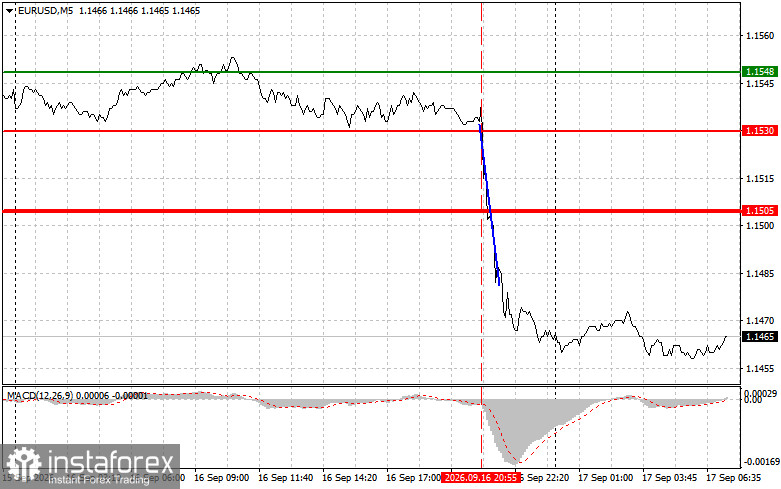
The price test at 1.1530 occurred as the MACD indicator began moving down from the zero line, confirming a correct entry point to sell the euro. As a result, the pair collapsed by more than 50 pips.
The Federal Reserve's unanimous 25-bp rate increase (12–0) contrasted sharply with July's meeting, when three FOMC members voted against a pause and pressed for immediate action. Kevin Warsh attributed the shift to an improving labor market and economy, too-slow disinflation, and changed geopolitical risks. Even more important was the revised outlook: the median year-end rate rose to 4.125% from 3.75%, and a large majority — 16 of 18 officials — now price in at least one more hike before year-end.
For the euro, such a hawkish shift in US policy widens the policy divergence across the Atlantic. The European Central Bank, despite being the most resolute G7 central bank, has indicated that its recent hike is more likely to complete a cycle than start a long series. Against that backdrop, the much more aggressive Fed stance tilts the scales sharply toward the dollar. I believe this interest-rate trajectory gap, rather than current euro-area macro data, will determine EUR/USD in the days ahead. Without a countervailing hawkish turn from Lagarde or Schnabel, the pair will struggle to find a reason to recover.
The key release for the euro this morning will be euro-area August inflation: the market expects 3.3% headline and 2.4% core. That publication will wrap up the month's inflation story across the region and serve as the last major guide before participants fully shift to assessing the Fed's decision consequences. In my view, today's numbers can temporarily offset the Fed's negative impact only if they surprise meaningfully to the upside. Higher inflation would give the euro an argument for a partial rebound after yesterday's sell-off, as markets would interpret it as a reason for further ECB tightening. If the prints meet expectations or come in lower, I do not expect any material EUR/USD reaction, and the pair will most likely continue moving in line with yesterday's Fed outcome.
For intraday strategy, I will rely mainly on Scenarios No. 1 and No. 2.
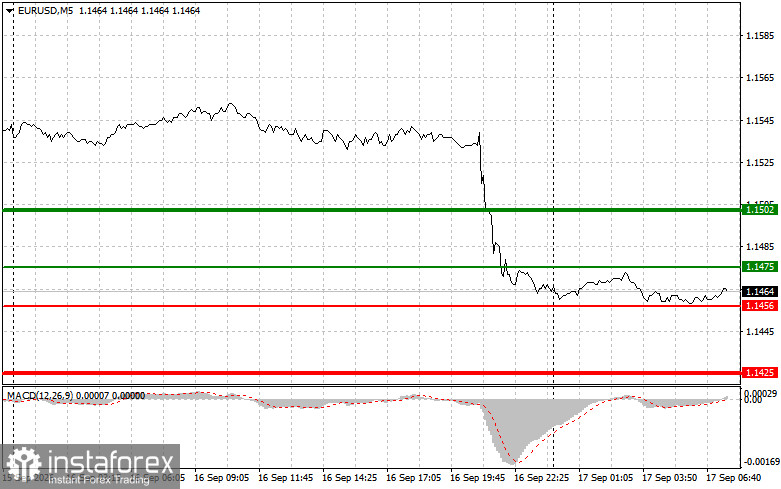
Scenario No. 1: Today you can buy the euro if the price reaches around 1.1475 (green line on the chart), targeting a rise to 1.1502. At 1.1502, I plan to exit long positions and also sell the euro in the opposite direction, aiming for a 30–35 pip move from the entry. Expect euro gains only as part of a corrective move. Important: before buying, ensure the MACD is above zero and only beginning to rise.
Scenario No. 2: I also plan to buy the euro today in case of two consecutive tests of 1.1456 while the MACD is in oversold territory. This would limit the pair's downside potential and lead to an upward reversal. One can expect moves to the opposite levels 1.1475 and 1.1502.
Scenario No. 1: I plan to sell the euro after it reaches 1.1456 (red line on the chart). The target will be 1.1425, where I plan to exit short positions and immediately buy in the opposite direction (expecting a 20–25 pip reversal from that level). Pressure on the pair will return today if data are weak. Important: before selling, ensure the MACD is below zero and only beginning to fall.
Scenario No. 2: I also plan to sell the euro today in case of two consecutive tests of 1.1475 while the MACD is in overbought territory. This would limit the pair's upside potential and trigger a reversal down. Expect a decline to the opposite levels 1.1456 and 1.1425.
Important: Beginner traders in the Forex market need to be very cautious when making entry decisions. It is best to stay out of the market ahead of significant fundamental reports to avoid being caught in sharp price fluctuations. If you decide to trade during news releases, always set stop orders to minimize losses. Without stop orders, you can quickly lose your entire deposit, especially if you do not employ money management practices and trade large volumes.
Also, remember that successful trading requires a clear trading plan, similar to the one provided above. Making spontaneous trading decisions based on current market conditions is inherently a losing strategy for intraday traders.


