
Voir aussi


 10.09.2026 05:01 AM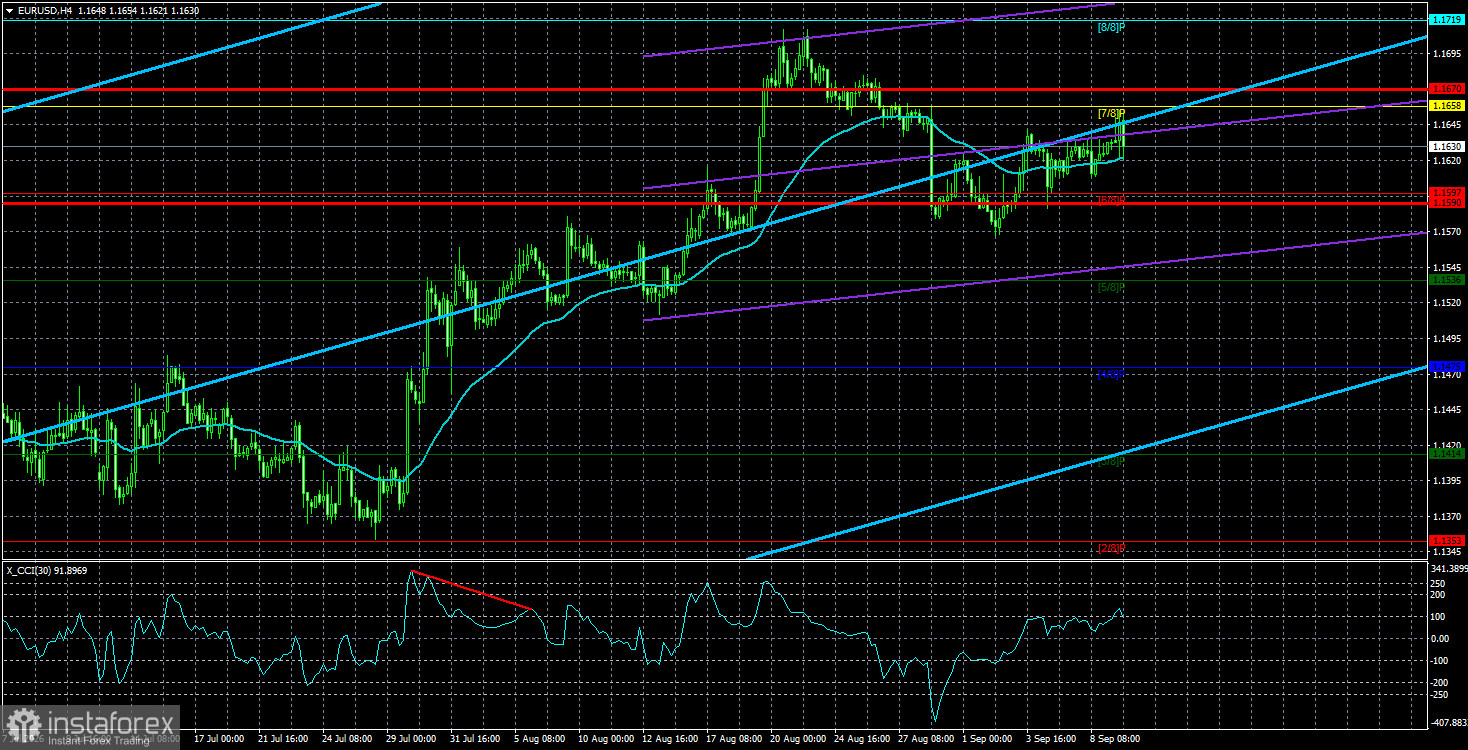
The EUR/USD currency pair was again largely immobilized on Wednesday. No major macroeconomic releases hit the day, and nothing dramatic was expected from Christine Lagarde's remarks — simply because the European Central Bank meeting takes place today, and it is unlikely the president would discuss monetary policy, future plans, or the decision to be announced. Traders could only be patient and wait for the X hour.
We know that the ECB will almost certainly raise rates by 25 basis points today — a 99% probability. Will the euro benefit? Recall that recent ECB meetings have generally been ignored by traders, even when rates were increased. The market has signaled it currently cares primarily about Federal Reserve meetings, and the next Fed meeting is next week, together with the Bank of England meeting. Because today's decision is widely anticipated, there is effectively nothing new for the market to react to. We do expect a certain emotional spike, but likely nothing more.
Lagarde's press conference can provoke a stronger reaction than the rate decision itself. If she hints the September hike will not be the last, the euro could rally significantly more than on the mechanical tightening. Yet we doubt Lagarde will offer forward guidance now: central banks face deep uncertainty — inflationary, energy, geopolitical and political — so making forecasts or promises when the future is so unclear would be unwise.
As a result, we expect more activity today than in the past few days and compared with the last six weeks, but not strong volatility. The day will probably finish with a move of 60–70 pips and will have little effect on the current technical picture. And the technical picture continues to support the euro across most timeframes. Only the daily timeframe still shows a yearly flat, but that will end eventually.
The market is reluctant to move because the US CPI, the Fed meeting, and the BoE meeting are all coming up. Next week may remove the market's block and produce more substantial moves. At the moment, the US inflation report likely matters even more than today's ECB decision. The market still watches Fed officials' actions and rhetoric above all. We cannot say the Fed is set to be hawkish at the moment; even if the ECB decision produces little reaction, the euro should continue to rise in the medium term.
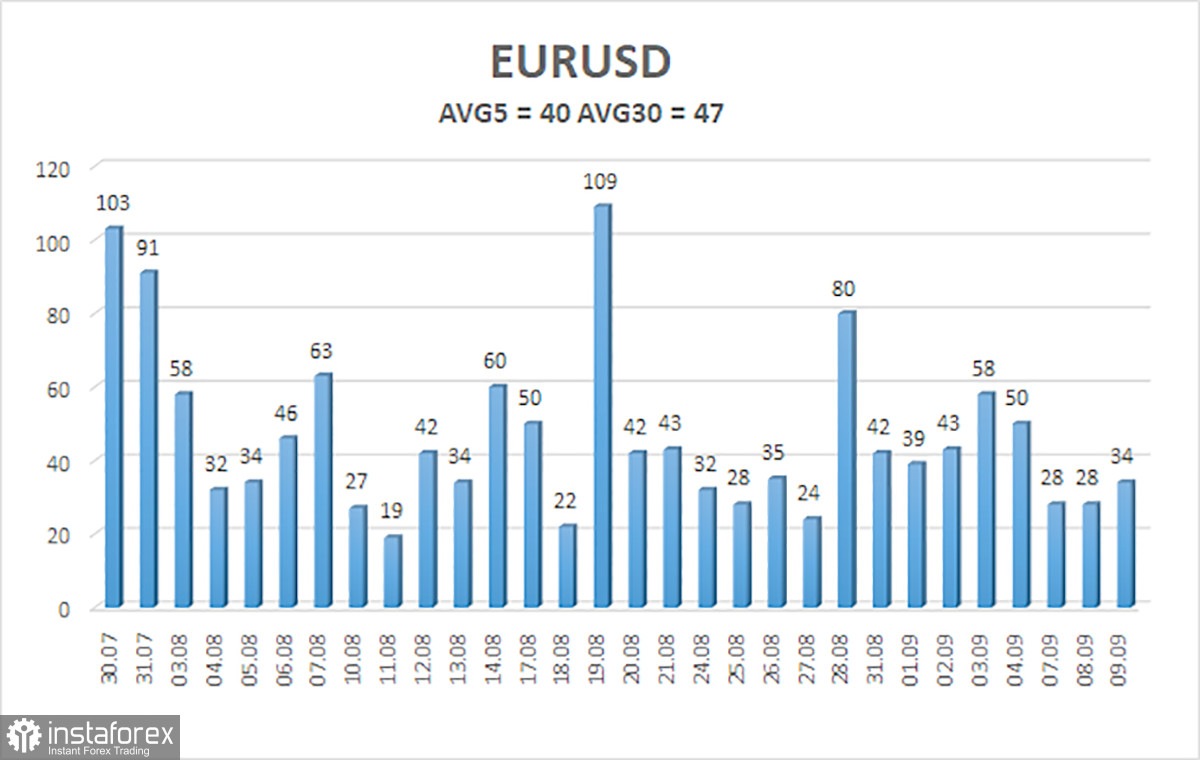
Average volatility of EUR/USD over the last 5 trading days as of September 10 is 40 pips — "low." We expect the pair to trade between 1.1590 and 1.1670 on Thursday. The major linear-regression channel points up, indicating an uptrend. The CCI entered oversold territory, warning that the correction may be ending.
S1 – 1.1597
S2 – 1.1536
S3 – 1.1475
R1 – 1.1658
R2 – 1.1719
R3 – 1.1780
EUR/USD continues an uptrend on the 4-hour timeframe, and this may be the start of a new leg of a global uptrend on higher timeframes. The global fundamental backdrop for the dollar remains negative overall: in 2026, geopolitics and then the Fed's hawkish tilt supported the dollar, but these factors no longer help it. With price below the moving average, consider shorts on a corrective basis, targeting 1.1597 and 1.1590. Above the moving average, long positions remain relevant, with targets at 1.1658 and 1.1670.
Regression channels help determine the current trend. If both are directed in the same direction, it means the trend is currently strong;
The moving average line (settings 20,0, smoothed) defines the short-term trend and the direction in which trading should be conducted at present;
Murray levels are target levels for moves and corrections;
Volatility levels (red lines) are the probable price channel within which the pair will spend the next 24 hours based on current volatility indicators;
The CCI indicator – its entry into the oversold area (below -250) or the overbought area (above +250) indicates that a trend reversal in the opposite direction is approaching.

