
यह भी देखें


 15.09.2026 08:51 AM
Yesterday, a confident dollar held the initiative against the euro and the pound ahead of the two-day Federal Reserve meeting starting today. The euro fell to 1.1525 on Monday, the pound refreshed a monthly low near 1.3465, and although both currencies bounced from local lows, the bearish trend that has persisted since late August remains intact.
I'll single out Christine Lagarde's speech, which unexpectedly focused not on monetary policy but on the artificial-intelligence boom. The European Central Bank president reminded listeners that euro-area households already hold roughly €440 billion in US tech stocks and warned that Europe lags in its own computing capacity. To my mind, this is background rather than a direct driver for the euro, but it is telling: while Europe debates how to catch up on AI infrastructure, the dollar continues to be supported by rate expectations.
Today the focus is on UK unemployment for July, forecast at 4.9% — unchanged for the fourth month running — and on average-earnings growth, which may slow to 3.9%. If the figures come in line with expectations, that will not trigger a reversal for sterling but will likely confirm its current weakness amid broad dollar dominance. Germany and the euro area will publish business-climate indices, and the US will release ADP and the Federal Reserve Bank of New York's manufacturing index, but I don't expect any of these releases to outweigh expectations for tomorrow's Federal Reserve decision. I do not expect any meaningful dollar correction before the Fed announces its outcome.
For the euro, a breakout above 1.1544 opens the way to 1.1563 and then 1.1579. That scenario is possible if today's business-climate data from Germany and the euro area markedly beat expectations and at least temporarily dampen the selling mood. More likely, in my view, is a break of 1.1525 to the downside, with targets at 1.1507 and 1.1486, since ahead of tomorrow's Fed decision the dollar is unlikely to cede initiative.
For the pound, a breakout above 1.3502 targets 1.3531 and 1.3565, but without surprises in labor-market data you should not count on such a move. A break below 1.3464, with targets of 1.3435 and 1.3401, looks more logical, especially if unemployment and wage data print in line with or weaker than forecasts.
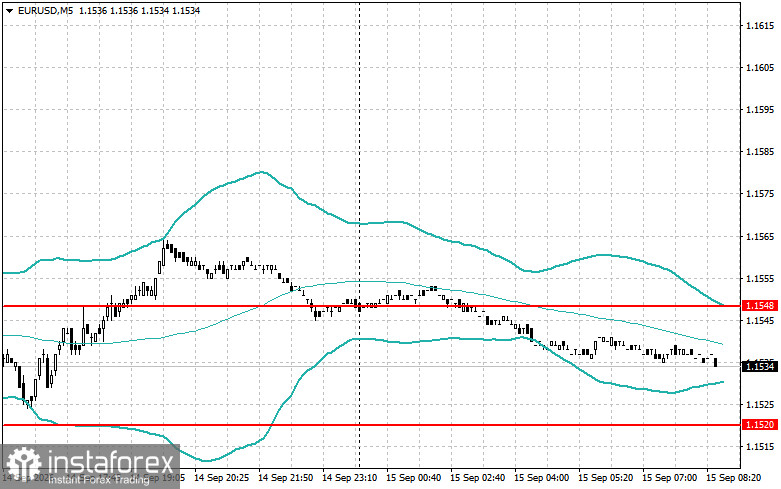
For the euro, I'm watching 1.1548 on the top and 1.1520 on the bottom. The range is narrow, which is natural ahead of the Fed meeting — market participants are unlikely to take large positions against the dollar a day before the decision. A false move above 1.1548, followed by a quick return inside, would fit the overall wait-and-see picture; in that case, it makes sense to place the stop just above the level.
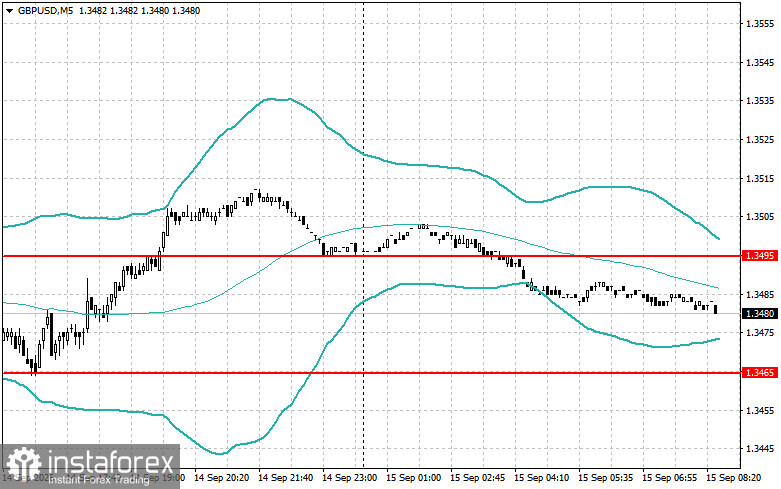
For the pound, I'm focusing on 1.3495 above and 1.3465 below. Expectations for UK labor-market data also compress this range: if the figures print neutral, a false breach of the borders with a return rather than a sustained breakout is likely. To test the lower boundary at 1.3465, unemployment or wage data would need to disappoint noticeably versus forecasts; in that case, it makes sense to place the stop just below the level.

