
อ่านรายละเอียดเพิ่มเติม


 10.09.2026 09:05 AM
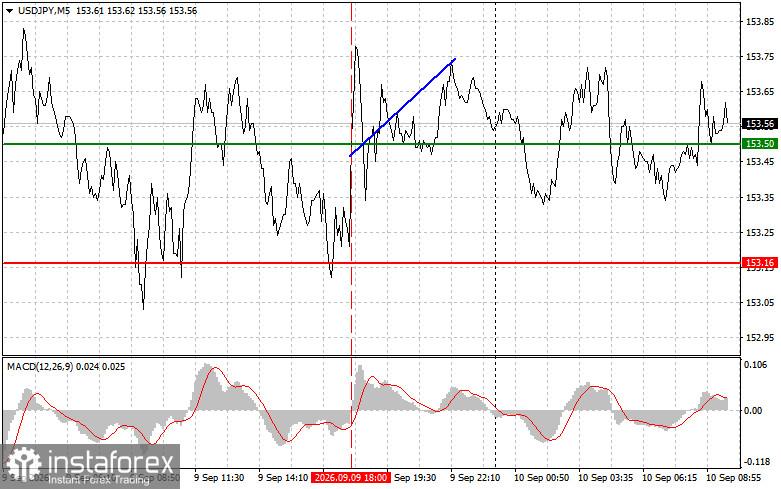
The price test of 153.50 occurred as the MACD indicator began moving up from the zero line, confirming the right entry point to buy the dollar. As a result, the pair rose about 30 pips.
The absence of important US data and hawkish signals from the Bank of Japan put pressure on the dollar and supported the yen yesterday. This time the source was board member Kazuyuki Masu. He said the central bank intends to continue raising the policy rate to keep inflation from running materially above 2%, and that current financial conditions are still loose. The policy rate reflects monetary-policy tightness, and such comments directly reinforce widely held expectations that borrowing costs in Japan will rise next week. Essentially, everyone now expects a rate hike, and Masu's remarks strengthen that conviction.
Importantly, this is not positioned as a one-off step but as a continuation of the cycle. Masu indicated that normalization requires further rate increases to put the policy rate firmly in the neutral range, estimated roughly between 1.1% and 2.5%. Next week, the central bank is leaning toward a 25 bp hike to 1.25%, and I view that as only the first stage of a tighter trajectory. The prospect of sustained normalization is narrowing the policy gap between the BOJ and a Federal Reserve that is cautious about easing, which favors the yen.
I believe that as long as the market prices in a rate hike and sees the BOJ ready to move further, the yen has a solid foundation for strengthening.
For intraday strategy, I will rely mainly on executing Scenarios No. 1 and No. 2.
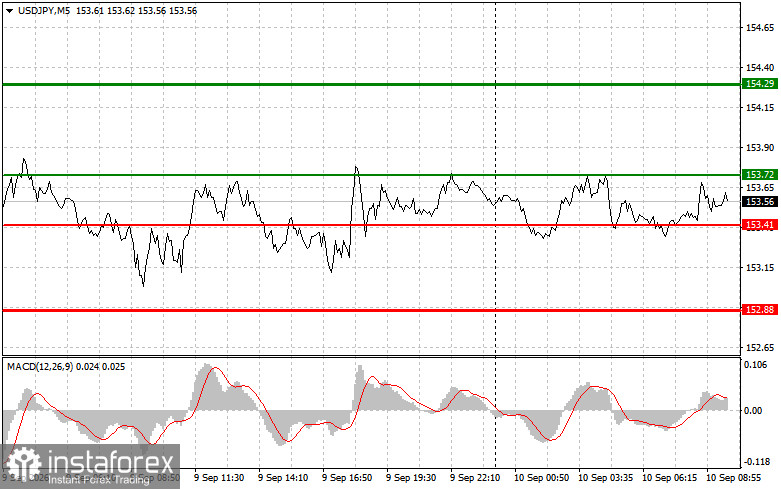
Scenario No. 1: I plan to buy USD/JPY today if the entry point around 153.72 (the green line on the chart) is reached, with a target to rise to 154.29 (the thicker green line on the chart). Around 154.29, I intend to exit long positions and open short positions in the opposite direction (expecting a 30–35 pip move in the opposite direction from that level). It is best to return to buying the pair on corrections and significant pullbacks. Important! Before buying, make sure the MACD indicator is above the zero line and is just beginning to rise from it.
Scenario No. 2: I also plan to buy USD/JPY today in the event of two consecutive tests of 153.41 when the MACD indicator is in an oversold area. This will limit the pair's downside potential and lead to an upward reversal. One can expect a rise toward the opposite levels of 153.72 and 154.29.
Scenario No. 1: I plan to sell USD/JPY today only after the 153.41 level (the red line on the chart) is broken, which will lead to a rapid decline in the pair. The key target for sellers will be 152.88, where I plan to exit shorts and immediately open longs in the opposite direction (expecting a 20–25 pip move in the opposite direction from that level). Sellers will return at any moment — we only need any hint from the central bank. Important! Before selling, make sure the MACD indicator is below the zero line and is just beginning to decline from it.
Scenario No. 2: I also plan to sell USD/JPY today in the event of two consecutive tests of 153.72 when the MACD indicator is in an overbought area. This will limit the pair's upside potential and lead to a downward reversal. One can expect a decline toward the opposite levels of 153.41 and 152.88.
Important: Beginner traders in the Forex market need to be very cautious when making entry decisions. It is best to stay out of the market ahead of significant fundamental reports to avoid being caught in sharp price fluctuations. If you decide to trade during news releases, always set stop orders to minimize losses. Without stop orders, you can quickly lose your entire deposit, especially if you do not employ money management practices and trade large volumes.
Also, remember that successful trading requires a clear trading plan, similar to the one provided above. Making spontaneous trading decisions based on current market conditions is inherently a losing strategy for intraday traders.


