
อ่านรายละเอียดเพิ่มเติม


 10.09.2026 01:57 PM
US Treasury Secretary Scott Bessent urged lawmakers to pass the CLARITY Act immediately after the Senate returns from its August recess next Monday. "I strongly urge everyone to stay at the negotiating table, agree to a procedural vote and continue the legislative process," he wrote, warning that the bill's failure would send a troubling signal about America's leadership in the digital-asset industry.

The wording reveals growing nervousness within the administration, since such public appeals typically appear when the outcome of a vote looks uncertain rather than a foregone conclusion in favor of the bill.
The statement came a week after the National Sheriffs' Association withdrew its opposition to the crypto-market structure bill, shifting to a neutral stance on September 3. That helps CLARITY Act supporters by removing one law-enforcement voice from the opposition, but it does not resolve the deeper problem: the banking industry and a majority of Democrats continue to insist the bill would allow crypto firms to offer yields on stablecoins without meeting the same requirements applied to banks. This confrontation is why forecasts for the bill's odds of passage in 2026 have been repeatedly revised downward in recent months.
Does the sheriffs' neutrality signal a turnaround in negotiations? Not yet — the bill already cleared the Senate Banking Committee in May, but it ran into resistance there that has not been overcome in the intervening months. In my view, Galaxy's collapse in its probability estimate from 75% to 10% speaks far more eloquently about the real balance of power than any public appeals by Bessent, and I wouldn't rule out that even securing a procedural vote — which the secretary is calling for — may not guarantee the bill's substantive passage within the remaining time.
Current technical picture for the crypto market
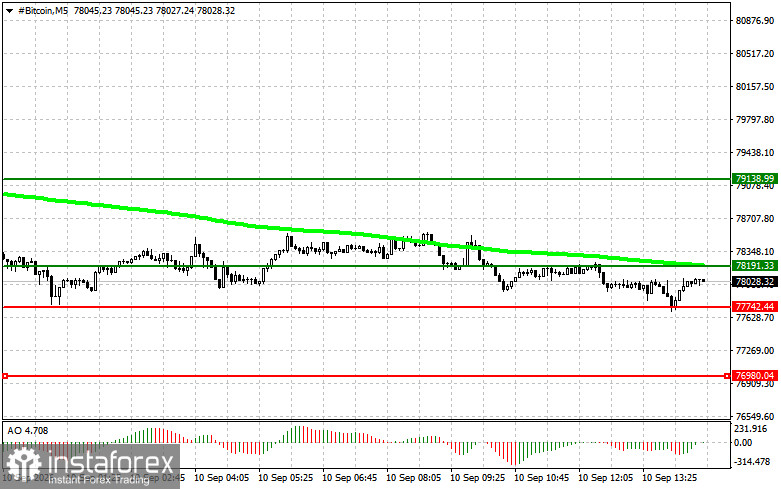
Bitcoin is holding in a tight range, and the trading plan is built around two mirror directions with two entry options each. A confirmed breakout above $78,200 opens a buy targeting $79,100, where it makes sense to take profits and consider a short on a pullback. The entry condition is mandatory: price must remain above the 50-day moving average confirming the bullish backdrop, and the Awesome Oscillator must be in positive territory. The second buy scenario trades the rebound: if price approaches $77,700 but a break lower fails to follow through, treat it as a false breakout and open a long targeting $78,200 and then $79,100.
Sell positions are structured in the opposite direction. A confirmed break below $77,700 enables a short position with a target at $76,900; conditions are mirrored (moving average above price and Awesome below zero). The second sell scenario trades the rejection: if price nears $78,200 but an upside breakout is not confirmed, go short with targets first at $77,700 and then $76,900.
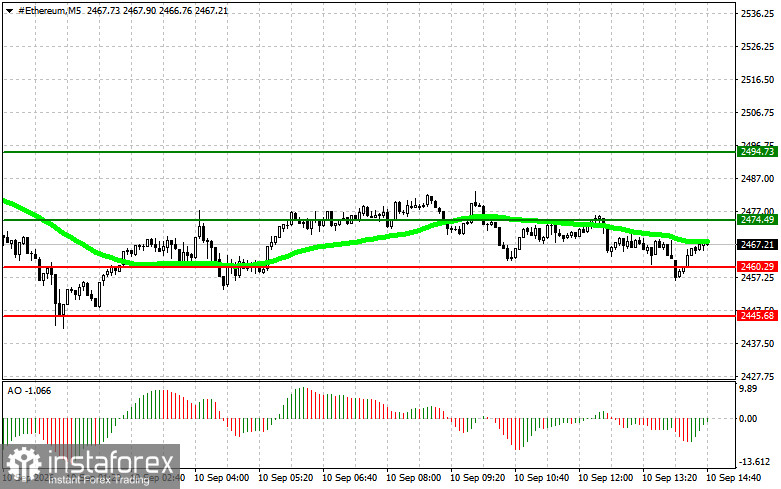
Ethereum follows the same logic on its own price scale. A breakout above $2,474 signals a buy targeting $2,494, under the same conditions (rising moving average below price and Awesome positive). The second buy scenario trades the bounce at $2,460 if a break below is not confirmed, targeting $2,474 and then $2,494.
Sell setups begin on a confirmed break below $2,460 with a target at $2,445, provided price is below the moving average and the Awesome Oscillator is negative. The second short works off a rejection at $2,474 if an upside breakout fails, targeting $2,460 and then $2,445. Both indicators serve only as filters to weed out false moves, not as standalone pre-entry signals, so trades should be executed only after price confirms the specified levels.


