
Xem thêm


 15.09.2026 02:01 PM
Analysis of Trades and Trading Advice for the British Pound
The price test of 1.3466 occurred when the MACD indicator had already moved significantly below the zero line, limiting the pair's downward potential. For this reason, I did not sell the pound.
The UK labor market data proved mixed, and this divergence determined the pound's reaction. On the one hand, the number of applications for unemployment benefits rose by as much as 27,800 in August after declining by 11,800 in July. This came as an unpleasant surprise to the market and triggered the first wave of GBP/USD selling. A sharp reversal in an indicator is always perceived more strongly against the backdrop of a previous decline, which is why this component of the report accounted for most of the negative reaction. On the other hand, the unemployment rate remained unchanged at 4.9%, failing to confirm market concerns about a sharper deterioration in labor market conditions. In my view, this was precisely what prevented the sell-off from developing into something more significant: without an increase in overall unemployment, the arguments for a more accommodative stance by the Bank of England are not as clear-cut as they may have appeared immediately after the unemployment benefit figures were released. As a result, although the pound remained in negative territory, in my view it still has a chance to stabilize if the rest of the day does not bring any new concerns related to the fiscal agenda.
In the second half of the day, the market will focus on ADP employment data and the Empire Manufacturing Index, for which expectations point to a notable deterioration, from 20.6 to 14.1 points in September. If the data comes in stronger than expected, I believe the dollar will see a new wave of demand, providing an additional argument in favor of a rate hike at the upcoming Federal Reserve meeting. In this situation, the pound will once again be at the mercy of external market factors.
As for the intraday strategy, I will focus more on the implementation of Scenarios No. 1 and No. 2.
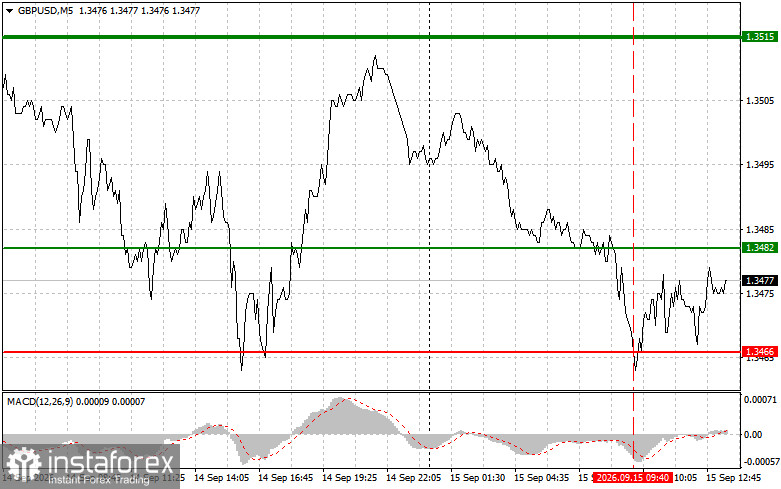
Buy Signal
Scenario No. 1: I plan to buy the pound today when the entry point is reached around 1.3482 (the green line on the chart), with a target of rising toward 1.3515 (the thicker green line on the chart). Around 1.3515, I will exit my long positions and open short positions in the opposite direction (targeting a move of 30–35 points in the opposite direction from the level). Today, any rise in the pound can only be expected as part of a correction. Important! Before buying, make sure that the MACD indicator is above the zero line and is just beginning to rise from it.
Scenario No. 2: I also plan to buy the pound today if the price tests 1.3466 twice consecutively while the MACD indicator is in the oversold area. This will limit the pair's downward potential and lead to a reversal of the market to the upside. A rise toward the opposite levels of 1.3482 and 1.3515 can be expected.
Sell Signal
Scenario No. 1: I plan to sell the pound today after the 1.3466 level is broken (the red line on the chart), which should lead to a rapid decline in the pair. The key target for sellers will be 1.3436, where I will exit my short positions and immediately open long positions in the opposite direction (targeting a move of 20–25 points in the opposite direction from the level). Strong pressure on the pound could return at any time. Important! Before selling, make sure that the MACD indicator is below the zero line and is just beginning to fall from it.
Scenario No. 2: I also plan to sell the pound today if the price tests 1.3482 twice consecutively while the MACD indicator is in the overbought area. This will limit the pair's upward potential and lead to a reversal of the market to the downside. A decline toward the opposite levels of 1.3466 and 1.3436 can be expected.
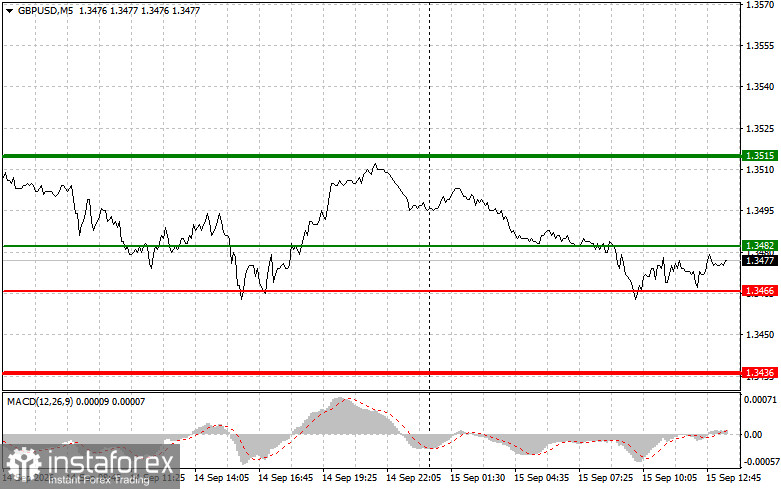
What Is Shown on the Chart:
Important. Beginner Forex traders should be extremely cautious when making decisions about entering the market. Before the release of important fundamental reports, it is best to stay out of the market to avoid being caught in sharp price fluctuations. If you decide to trade during the release of news, always place stop orders to minimize losses. Without stop orders, you can lose your entire deposit very quickly, especially if you do not use proper money management and trade large volumes.
And remember that successful trading requires a clear trading plan, such as the one presented above. Making spontaneous trading decisions based on the current market situation is an inherently losing strategy for an intraday trader.

